Sunset in Brisbane moves from 5:00 pm in mid-June to 6:45 pm in mid-January. The wet season runs roughly November to March, and its storms build in the late afternoon, which is the same part of the day your portraits need.
Those two facts do more to determine how your photographs look than the venue does. But the venue decides where the light falls when it arrives, and whether you have anywhere to go when it does not.
How this list is ordered
Four things, weighted in this order.
Light at the working hour. Not how the place looks in a brochure at eleven in the morning. How it looks in the ninety minutes before sunset, when the portraits are actually being made.
A wet-weather plan that exists. Most of the best-photographing locations in Brisbane are public parks with no cover at all. That is not a fault, but it is a fact you have to plan around.
Distance between ceremony and portraits. Every kilometre between them is coverage you paid for and spent in a car.
How much of it you get to yourself. Free public parkland on a Saturday afternoon in October is not empty.
1. New Farm Park
The Moreton Bay figs are the reason. Their canopies throw an enormous, soft shade that holds all afternoon, which means you are not chasing a shrinking patch of open shade the way you are almost everywhere else on this list. The rose gardens give structure, the open lawns give backlight, and the jacarandas flower late October into November if you are lucky with timing.
Best hour. Last ninety minutes before sunset on the open lawns for backlight; any time from mid-afternoon under the figs.
Wet weather. None worth the name. The fig canopies will hold off five minutes of drizzle and nothing more. If this is your ceremony site, you need a second address on the run sheet.
Watch out for. Company. Weekend afternoons bring picnics, dogs, cricket and often another wedding party working the same three trees. Get there early or work the eastern side.
2. Kangaroo Point Cliffs Park
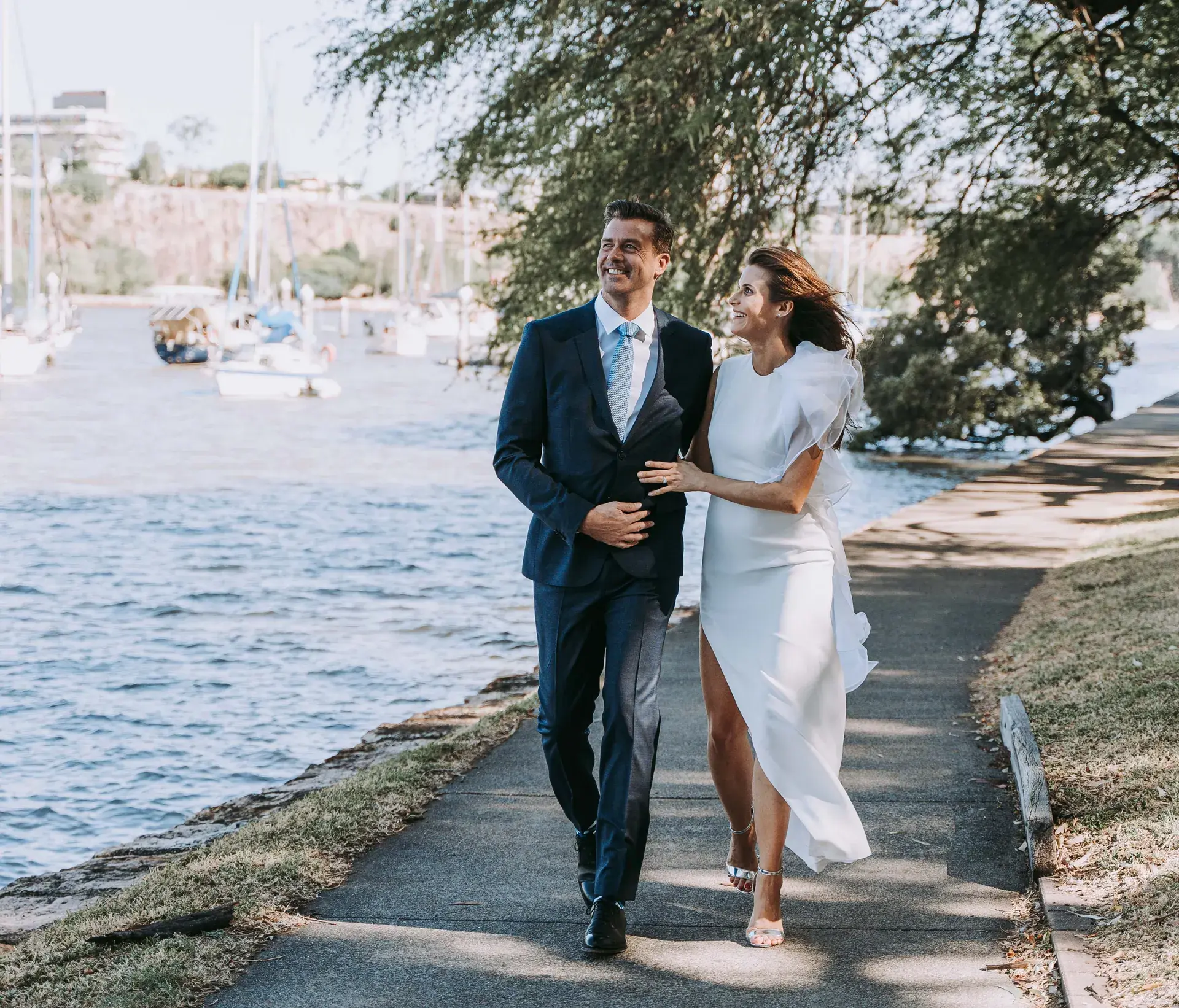
The cliff-top parkland faces north-west across the river to the CBD, which is why it is the most photographed skyline position in the city. Late in the day the sun comes from behind and to the side of the towers, so a couple standing with the city behind them is properly backlit rather than squinting into it. Then the office lights come on during civil twilight and the whole background changes character within about twenty minutes.
The base of the cliffs along Riverside Drive is a different location entirely: sheer rock face, hard texture and deep shade. Worth ten minutes if you are already there.
Best hour. Thirty to forty minutes before sunset for the skyline, and stay another twenty for the lights.
Wet weather. Nothing. It is an exposed clifftop.
Watch out for. Wind, which is stronger up there than at street level and will find every loose piece of a hairstyle and a veil. It is also a busy public park.
3. City Botanic Gardens, Gardens Point
Bunya pines, an avenue of weeping figs, a mangrove boardwalk and the river on two sides, all within a few minutes of the CBD hotels. The variety inside one short walk is the best in Brisbane.
The catch is the shade line. The city towers sit to the west, so the gardens fall into flat shadow noticeably before the published sunset time, often by forty minutes. That is not a problem if you know it. It is a problem if your timeline was built off a sunset app.
Best hour. Mid-afternoon through to about an hour before sunset. Do the open river edge first and move into the figs as the shadow arrives.
Wet weather. None on site. The upside is proximity. The CBD hotels are a five-minute walk, and a hotel lobby is a legitimate fallback.
Watch out for. That shade line moves seasonally as well as daily. Scout it at the same time of year, not just the same time of day.
4. Howard Smith Wharves
An unusual advantage here: the cliff face behind the precinct takes direct sun off the site early in the afternoon. Most sites that lose the sun that early are a problem. This one is not, because the reflected light coming off the river and the pale cliff gives you soft, even light for hours, with the Story Bridge overhead as a background that needs no explanation.
Best hour. Mid to late afternoon in the shadow of the cliffs, then again after dark once the bridge is lit.
Wet weather. This is one of the few entries on the list with a genuine answer, because it is a built precinct with indoor and covered spaces rather than a lawn. Confirm the specifics with whichever operator you are booking, because arrangements differ between venues within the precinct.
Watch out for. It is a public hospitality precinct on a Saturday night. Expect crowds in every wide frame, and plan the couple portraits for before the evening trade builds.
5. Mount Coot-tha
Two locations, twenty minutes apart in character. The Botanic Gardens at the base give you a lagoon, mature subtropical planting and the Japanese Garden. The summit lookout gives you the whole city laid out to the east, with Moreton Bay behind it on a clear day.
The lookout works at sunset for a reason that is easy to miss: the sun is behind you, so the city itself is what turns gold. You are photographing the warm light rather than into it.
Best hour. Last thirty minutes before sunset at the lookout, and the twenty minutes after, when the city lights come up while there is still colour in the sky.
Wet weather. The covered garden structures at the base are the practical option, and they require booking.
Watch out for. The drive. It is fifteen to twenty minutes each way from the CBD, which means Mount Coot-tha costs you the better part of an hour of coverage. On a six-hour package that is a real decision, not a detail. The lookout is also a tourist site, and coaches arrive at sunset.
6. Roma Street Parkland
Dense subtropical planting, terraced levels, lakes and an amphitheatre, all at the northern edge of the CBD. Photographically it is generous: you can produce six visibly different backgrounds without walking more than three hundred metres.
The buildings to the west take the sun off the lower terraces well before the official sunset time. Work downhill as the afternoon goes: start low while there is still light in the beds, finish high where the sun holds longest.
Best hour. Ninety minutes to thirty minutes before sunset, moving upward.
Wet weather. Nothing reliable.
Watch out for. Gradients and stairs. Anyone in heels will tell you about it afterwards. Walk the route yourself before you commit to it on a timeline.
7. Customs House
Heritage sandstone with a copper dome, on the river at the top end of Queen Street. The river frontage faces away from the western sun, which means the terrace holds soft, reflected light late into the afternoon and never gets hit directly. That is close to ideal for group photographs: nobody squints, and there are no hard shadows across a hundred faces.
Best hour. Late afternoon on the terrace for groups. The interior works whenever, because it is lit for itself.
Wet weather. It is a building. That is most of the point of choosing it.
Watch out for. Scale. It is a compact venue, and a large bridal party will feel the walls. Portraits generally happen on the terrace or a short walk along the river, so factor that walk into the timeline.
8. St John's Cathedral
Stone vaulting, tall stained glass, and a quality of light inside that does not exist anywhere else on this list. It is also dim, and the colour temperature is mixed: daylight through coloured glass over the top of warm artificial light. This is a fast-lens, high-ISO room, and a photographer who has not worked a cathedral before will struggle in it.
Best hour. Late morning to mid-afternoon, when there is enough sun outside to push through the glass.
Wet weather. Fully covered, obviously. The consideration is where the guests and the group photographs go afterwards.
Watch out for. Rules. Photography conditions during a church service vary by church and by celebrant: where the photographer may stand, how far forward, whether flash is permitted at all. Ask early and get the answer in writing, because it changes how coverage is planned rather than just where someone stands.
9. Cleveland Point Reserve
Out in the Redlands at the tip of the point, with the old timber lighthouse, mature trees and open water toward Stradbroke. It faces roughly east over the bay, which flips the usual logic. This is a morning location first and a last-light location second, with the water lit behind you rather than the sky.
Best hour. Early morning, or the final hour before sunset with the bay behind the couple.
Wet weather. None on the point itself.
Watch out for. Distance. It is about forty minutes from the Brisbane CBD, so it belongs to a day that is already happening in the Redlands or the bayside. Wind off the water is constant, and the reserve is a popular public spot.
10. Shorncliffe Pier
The pier runs out east into Bramble Bay from Brisbane's northern bayside, with parkland at the landward end. It is a sunrise location before it is anything else: long timber lines, open water, and light coming straight down the deck.
Best hour. Sunrise, without much competition. Late afternoon works differently: the pier itself falls into its own shade while the bay stays lit, which is quieter and less obvious than the sunrise version.
Wet weather. None.
Watch out for. It is entirely public and it is used. Fishers are there before you are, and walkers use it continuously. Nobody will be unkind about it, but you will not have it to yourself.
Two rules that apply everywhere
Do not start a summer ceremony at two o'clock. Between December and February, a 2:00 pm ceremony puts your guests in direct sun at close to the hottest part of a humid day, and puts your first photographs in the harshest light of the year. Sunset in mid-January is near 6:45 pm, so a 4:00 to 4:30 pm start gives you a ceremony in softening light, time for family groups, and portraits landing around 6:05 pm when it is genuinely good. Winter reverses it. With sunset at 5:00 pm in June, 2:45 pm is the latest a ceremony can reasonably begin. The month-by-month table has the figure for your date.
The trade-off worth naming: in the wet season, a late-afternoon ceremony carries more storm exposure than a morning one. Storms here build with the heat of the day. If rain frightens you more than harsh light does, go morning and book the portrait session separately for sunset.
Check the permit position early. Council parks generally require a booking for the ceremony, and commercial photography can carry its own permit requirement on top. Requirements change, so confirm the current rules with Brisbane City Council (or the relevant council, for anything outside the Brisbane local government area) before the invitations are printed with a time on them.
Worth the drive
The Sunshine Coast hinterland around Maleny sits high enough to be a different climate, with the Glass House Mountains as a background that no city location competes with. It also sits high enough to be inside the cloud on the wrong morning, which is the trade. The Gold Coast beaches face east, so plan them for sunrise rather than sunset. Ipswich has genuine heritage streetscapes that photograph well and cost nothing to use.
We photograph across all of it: Brisbane, Ipswich, the Gold Coast and the Sunshine Coast. Send us the venue and the date and we will tell you what the light is doing that week, and what the honest wet-weather answer is. Coverage packages start at $698.
The one question to ask every venue
Ask for the wet-weather alternative, then go and stand in it.
Not look at a photograph of it. Stand in it, at roughly the hour your ceremony would run, and decide whether you would be content to be married there. Plenty of couples change something once they have, and it is a far better conversation to have on a quiet weekday than at 3:00 pm on the day.